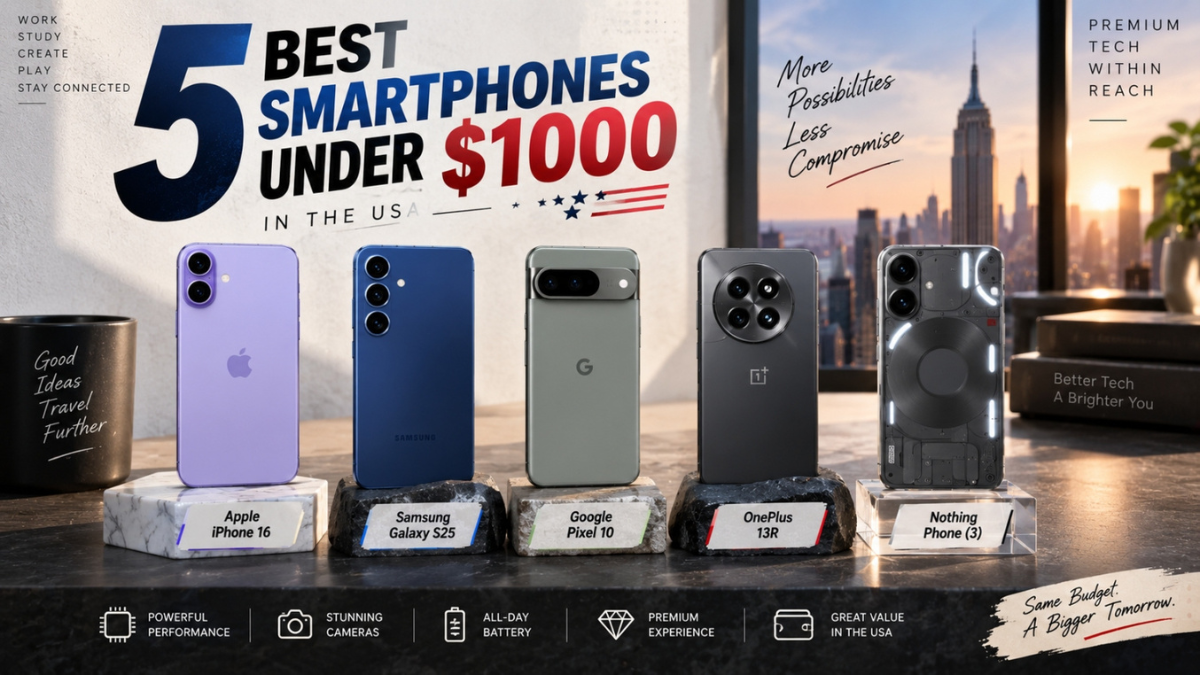
5 Best Smartphones Under $1000 in the USA (2026)
Introduction: How to Choose the Best Smartphones Under $1000 in the USA
Finding the Best Smartphones Under $1000 in the USA has become difficult because of the competition. The sub-$1000 smartphone category stopped being a “compromise” tier years ago. In 2026, flagship-grade chipsets, multi-year software support, and computational photography that used to cost $1,200+ now show up comfortably under the four-figure mark. That’s good news for buyers, but it also means the decision isn’t about specs on paper anymore — it’s about which ecosystem and priorities fit your life.
Before comparing individual phones, weigh these four factors:
- Ecosystem lock-in: If you already own an iPad, AirPods, or a Mac, staying in Apple’s ecosystem often outweighs raw Android hardware advantages. The reverse is true for Google/Android households.
- Software support window: Google and Samsung now offer 7 years of OS updates on their flagships; Apple typically supports iPhones for 6+ years. Longer support means a better resale value and a phone that doesn’t feel outdated in year three.
- Camera priorities: Computational photography (Google), color-accurate flagship optics (Samsung), or balanced all-rounder performance (Apple) — your priority here should drive your pick more than megapixel counts.
- Carrier vs. unlocked: Buying unlocked gives you full control over updates and resale value. Carrier-subsidized units can restrict features and complicate switching providers later.
With that framework in place, here are five smartphones that deliver real value under $1000 in the U.S. market right now.
1. Apple iPhone 16 — Best Overall Pick
Price: Starting at $799 (128GB)
Overview
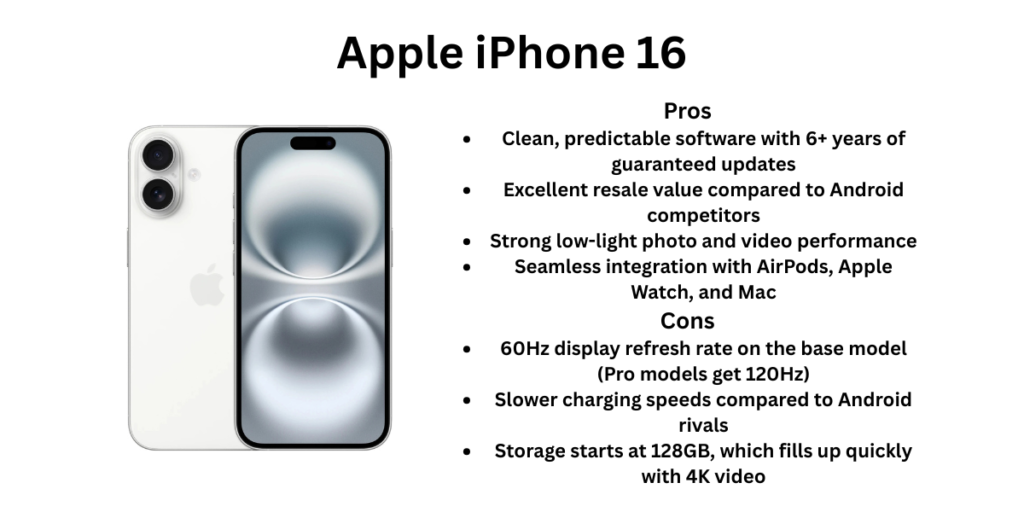
The iPhone 16 remains the safest pick for anyone who wants a smartphone that “just works” without needing to think about it. It runs on Apple’s A18 chip, supports Apple Intelligence features, and includes a redesigned Camera Control button plus an improved 48MP main sensor. Its biggest strength isn’t any single spec — it’s the combination of long-term software support, resale value, and ecosystem integration that Android phones still struggle to match.
Pros
- Clean, predictable software with 6+ years of guaranteed updates
- Excellent resale value compared to Android competitors
- Strong low-light photo and video performance
- Seamless integration with AirPods, Apple Watch, and Mac
Cons
- 60Hz display refresh rate on the base model (Pro models get 120Hz)
- Slower charging speeds compared to Android rivals
- Storage starts at 128GB, which fills up quickly with 4K video
Who Should Buy It
Anyone already invested in the Apple ecosystem, first-time smartphone buyers who want zero learning curve, and people who prioritize long-term resale value over cutting-edge specs. Many people consider this one of the best smartphones under $1000 in the USA.
2. Samsung Galaxy S25 — Best Android Flagship
Price: Starting at $799 (128GB)
Overview
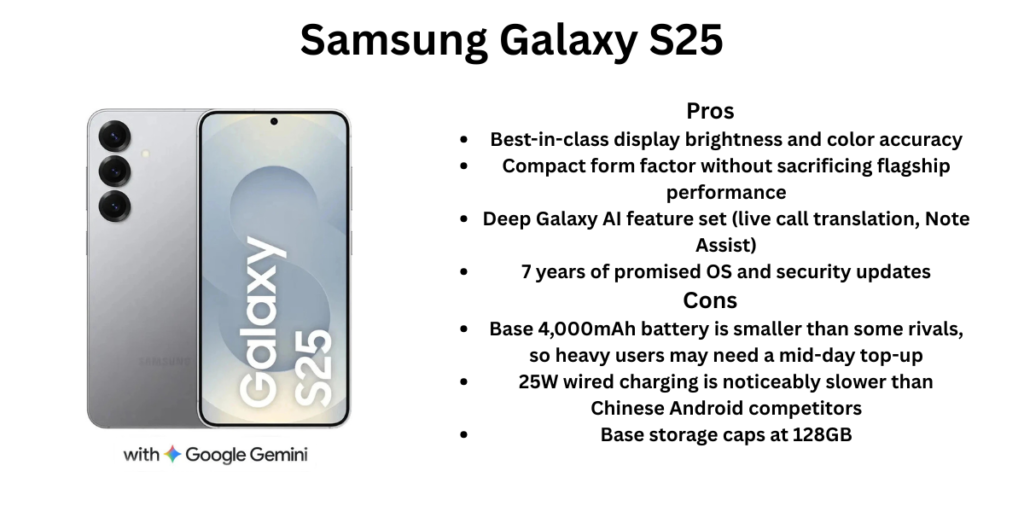
The Galaxy S25 packs a Snapdragon 8 Elite for Galaxy chip, a 6.2-inch Dynamic AMOLED 2X display at 120Hz, and Samsung’s expanding suite of Galaxy AI tools (live translation, circle-to-search, generative photo editing). It’s compact by 2026 flagship standards, which makes it one of the few true one-handed flagship options left.
Pros
- Best-in-class display brightness and color accuracy
- Compact form factor without sacrificing flagship performance
- Deep Galaxy AI feature set (live call translation, Note Assist)
- 7 years of promised OS and security updates
Cons
- Base 4,000mAh battery is smaller than some rivals, so heavy users may need a mid-day top-up
- 25W wired charging is noticeably slower than Chinese Android competitors
- Base storage caps at 128GB
Who Should Buy It
Android users who want a compact flagship, anyone deep in the Samsung ecosystem (Galaxy Watch, Galaxy Buds), and buyers who prioritize display quality above all else.
3. Google Pixel 10 — Best for Camera and AI Features
Price: Starting at $799
Overview
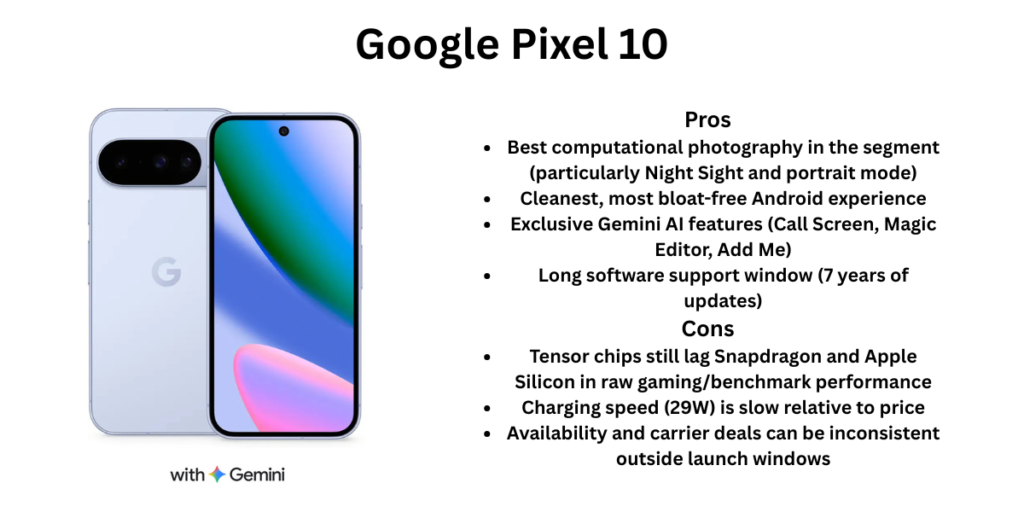
The Pixel 10 runs on Google’s Tensor G5 chip and continues Google’s strategy of prioritizing computational photography and on-device AI over raw benchmark numbers. Its 50MP main camera, paired with Google’s image processing, consistently produces some of the most natural-looking photos in this price range — especially in mixed and low lighting.
Pros
- Best computational photography in the segment (particularly Night Sight and portrait mode)
- Cleanest, most bloat-free Android experience
- Exclusive Gemini AI features (Call Screen, Magic Editor, Add Me)
- Long software support window (7 years of updates)
Cons
- Tensor chips still lag Snapdragon and Apple Silicon in raw gaming/benchmark performance
- Charging speed (29W) is slow relative to price
- Availability and carrier deals can be inconsistent outside launch windows
Who Should Buy It
Photography-focused buyers, people who want the most “stock” Android experience possible, and anyone who wants first access to Google’s newest AI features. Because of Google’s support, many users think this as one of the best smartphones under $1000 in the USA.
4. OnePlus 13R — Best Value for Performance
Price: Starting around $549–$599
Overview
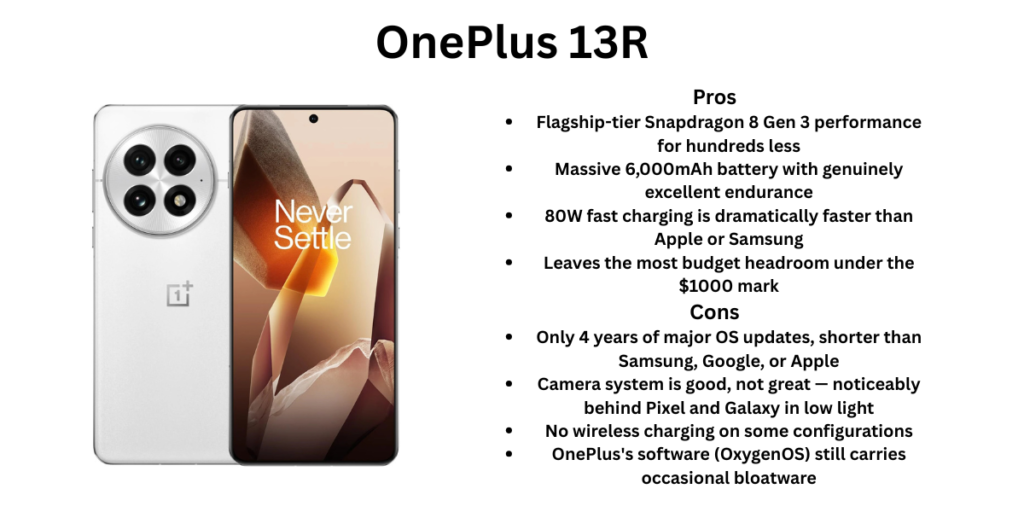
The OnePlus 13R is the clearest “flagship specs, mid-range price” option on this list. It runs the same Snapdragon 8 Gen 3 chip found in phones costing hundreds more, paired with a massive 6,000mAh battery and 80W fast charging that can take it from empty to full in well under an hour. It sacrifices some camera refinement and software polish to hit its price point, but for pure day-to-day performance per dollar, it’s hard to beat.
Pros
- Flagship-tier Snapdragon 8 Gen 3 performance for hundreds less
- Massive 6,000mAh battery with genuinely excellent endurance
- 80W fast charging is dramatically faster than Apple or Samsung
- Leaves the most budget headroom under the $1000 mark
Cons
- Only 4 years of major OS updates, shorter than Samsung, Google, or Apple
- Camera system is good, not great — noticeably behind Pixel and Galaxy in low light
- No wireless charging on some configurations
- OnePlus’s software (OxygenOS) still carries occasional bloatware
Who Should Buy It
Value-conscious buyers who want flagship-level speed and battery life without flagship pricing, and heavy phone users who prioritize all-day battery and fast charging over camera refinement.
5. Nothing Phone (3) — Best for Design and Standing Out
Price: Starting at $799 (256GB)
Overview
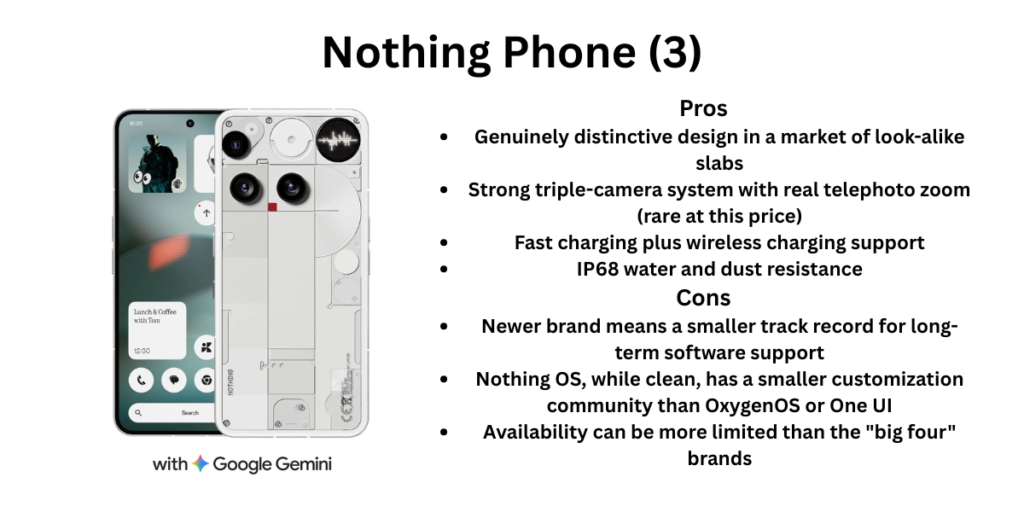
Nothing’s first true flagship is the design-forward pick on this list. Its signature transparent back and Glyph lighting interface make it instantly recognizable, but the substance backs up the style: a Snapdragon 8s Gen 4 chip, a triple 50MP camera system (main, periscope telephoto, ultrawide), and a 5,150mAh silicon-carbon battery with 65W wired and 15W wireless charging.
Pros
- Genuinely distinctive design in a market of look-alike slabs
- Strong triple-camera system with real telephoto zoom (rare at this price)
- Fast charging plus wireless charging support
- IP68 water and dust resistance
Cons
- Newer brand means a smaller track record for long-term software support
- Nothing OS, while clean, has a smaller customization community than OxygenOS or One UI
- Availability can be more limited than the “big four” brands
Who Should Buy It
Buyers who want their phone to look different from everyone else’s, camera enthusiasts who want telephoto zoom without paying Pro-tier prices, and early adopters comfortable with a newer brand. Because of its design, a lot of users consider this as one of the best smartphones under $1000 in the USA.
Conclusion: Final Recommendation
If you want the safest, most future-proof choice, the iPhone 16 is the pick — it holds resale value best and requires zero research to use well. If you’re an Android user who wants the best all-around flagship, the Samsung Galaxy S25 balances display quality, compact size, and long-term support better than anything else here. If photography and AI features matter most to you, the Google Pixel 10 is unmatched at this price. If you care more about raw performance and battery life than brand prestige, the OnePlus 13R gives you the most phone per dollar. And if you want a device that looks like nothing else on the market, the Nothing Phone (3) is worth the leap.
There’s no universally “best” phone under $1000 in 2026 — only the best phone for how you actually use your device. Match the phone to your priority list from the introduction, and any of these five will serve you well for years. Share this list of the Best Smartphones Under $1000 in the USA with your friends to help them.
Frequently Asked Questions
What is the best smartphone under $1000 in the USA right now?
For most buyers, the Samsung Galaxy S25 or iPhone 16 offer the best overall balance of performance, camera quality, and software longevity, both starting at $799.
Is it better to buy an unlocked phone or a carrier phone under $1000?
Unlocked phones generally receive faster software updates, retain higher resale value, and give you the freedom to switch carriers without restrictions. Carrier-subsidized phones can look cheaper upfront but often cost more over a 2-year period.
Which phone under $1000 has the best camera?
The Google Pixel 10 leads in computational photography and low-light performance, while the Nothing Phone (3) offers the best telephoto zoom in this price bracket.
How long will a $1000 smartphone last before needing an upgrade?
With 6–7 years of promised software updates from Apple, Samsung, and Google, a well-maintained flagship purchased in 2026 should remain secure and usable well into the early 2030s.
Also read: 6 Best Smartphones Under $300 in the USA