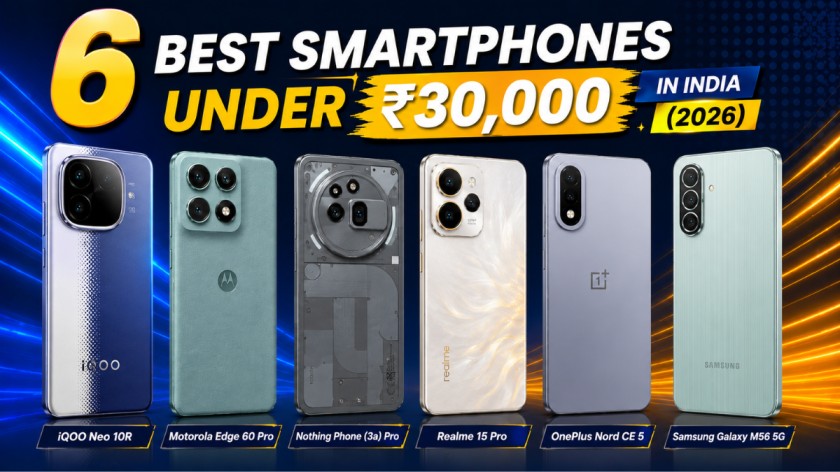
6 Best Smartphones Under ₹30,000 in India (2026) — Tested & Ranked
Let me be direct with you: finding the Best Smartphones Under 30,000 in India has quietly become the most exciting price segment in the entire smartphone market. Brands that used to save their best tricks for ₹50,000+ phones — periscope cameras, Snapdragon 8-series chips, 144Hz AMOLED displays, IP ratings — are now packing them into phones costing less than a decent weekend trip to Goa.
But that’s also the problem. There are too many options, and most “best of” lists just copy specs from GSMArena and call it a day.
This guide is different. I’ve gone through hands-on reviews, owner feedback on Reddit and forums, long-term durability reports, and camera comparisons from trusted Indian tech outlets to build a list I’d actually stand behind if a friend walked up to me in a showroom today.
Here’s what I prioritized:
- Real-world performance, not benchmark numbers
- Camera consistency across lighting conditions, not just megapixels
- Software support — how many years of updates will you actually get?
- Value durability — will it still feel fast in 2027?
Let’s get into it.
Quick Comparison: At a Glance
| Phone | Price | Chipset | Battery | Best For |
|---|---|---|---|---|
| iQOO Neo 10R | ~₹26,999 | Snapdragon 8s Gen 3 | 6,400mAh | Gaming & performance |
| Motorola Edge 60 Pro | ~₹27,999 | Dimensity 8350 | 6,000mAh | All-rounder, clean UI |
| Nothing Phone (3a) Pro | ~₹29,999 | Snapdragon 7s Gen 3 | 5,000mAh | Camera lovers, design fans |
| Realme 15 Pro | ~₹27,999 | Snapdragon 7s Gen 3 | 7,000mAh | Battery life + camera |
| OnePlus Nord CE 5 | ~₹24,999 | Dimensity 8350 Apex | 7,100mAh | Smooth daily use, clean OxygenOS |
| Samsung Galaxy M56 5G | ~₹27,999 | Exynos 1580 | 6,000mAh | Samsung loyalists, long updates |
1. iQOO Neo 10R — Best for Performance & Gaming
Starting Price: ~₹26,999 (Amazon)
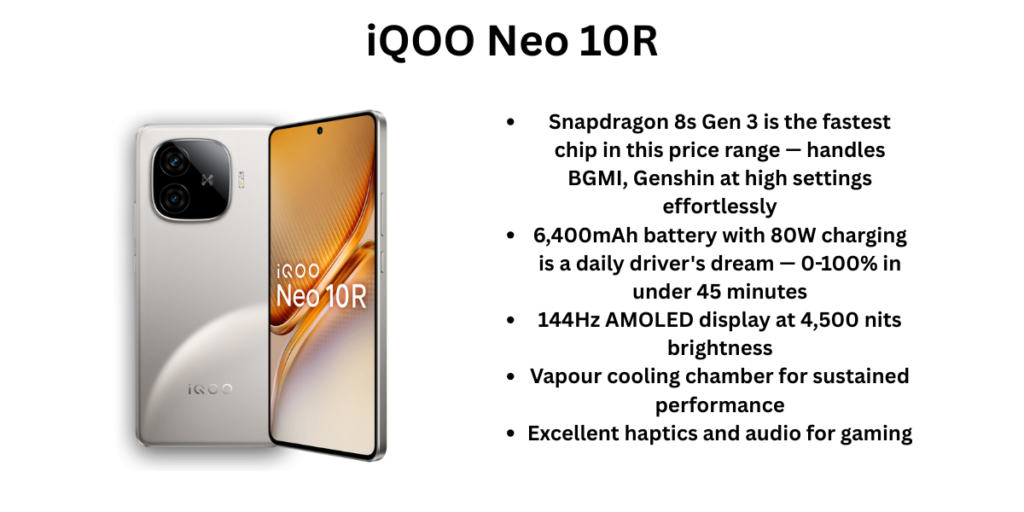
If you game on your phone — even occasionally — the iQOO Neo 10R should be the first phone you look at in this budget. Vivo’s sub-brand iQOO has built a cult following among Indian gamers, and the Neo 10R is the reason why.
Powered by the Snapdragon 8s Gen 3 chipset, the iQOO Neo 10R packs a 6,400mAh battery with 80W fast charging, and a 6.78-inch AMOLED display running at 144Hz. That spec sheet reads like something that should cost ₹40,000 two years ago.
The display deserves special mention — iQOO equipped this with a 1.5K 144Hz flat AMOLED panel rated at 4,500 nits of peak brightness, which means outdoor visibility is genuinely excellent — rare at this price. The vapor cooling chamber keeps sustained gaming sessions from turning your hand into a hotplate.
The iQOO Neo 10R has been recommended by professional esports players like Scout and Mortal, which tells you something about its gaming credibility that no spec sheet can.
On cameras, you get a 50MP primary + 8MP ultrawide setup. It’s solid for social media and everyday photography, though not in the same league as the Motorola Edge 60 Pro for versatility.
Pros:
- Snapdragon 8s Gen 3 is the fastest chip in this price range — handles BGMI, Genshin at high settings effortlessly
- 6,400mAh battery with 80W charging is a daily driver’s dream — 0-100% in under 45 minutes
- 144Hz AMOLED display at 4,500 nits brightness
- Vapour cooling chamber for sustained performance
- Excellent haptics and audio for gaming
Cons:
- Camera system is functional, not exceptional — ultrawide quality falls short of competition
- Bloatware out of the box (though manageable)
- Design is utilitarian — not the most stylish phone on this list
- Software updates commitment is 3 years, not industry-leading
Who Should Buy It: Competitive mobile gamers, students who stream and game heavily, or anyone who simply wants the fastest phone possible under ₹27,000. If your benchmark is BGMI frame rate and thermal management, nothing else touches this.
2. Motorola Edge 60 Pro — Best All-Rounder
Starting Price: ~₹27,999 (Flipkart)
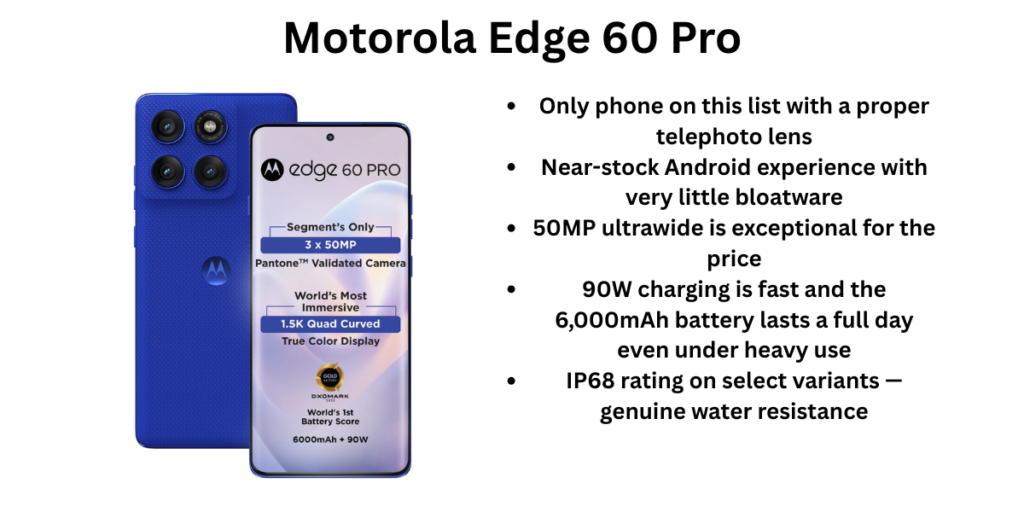
The Motorola Edge 60 Pro is the phone I’d recommend to someone who doesn’t want to think too hard about what they’re missing. It simply does everything well — and the camera system is genuinely impressive for the price.
The Edge 60 Pro features a borderless 6.7-inch pOLED display with a 120Hz refresh rate, powered by the MediaTek Dimensity 8350 Extreme chipset, with a 6,000mAh battery and 90W charging. The camera setup includes a 50MP main, 50MP ultrawide, and 10MP telephoto lens.
That triple-camera setup with a dedicated telephoto — at under ₹30,000 — is genuinely rare. Most competitors in this range ship with a mediocre depth sensor that’s basically useless. The 10MP telephoto gives you actual optical zoom, and the 50MP ultrawide is one of the widest and sharpest I’ve seen in this segment.
The Motorola Edge 60 Pro is considered one of the best all-rounder phones under ₹30,000, balancing strong performance, an AMOLED display, capable cameras, and reliable battery life.
Motorola’s software skin, Hello UI, remains one of the closest to stock Android you’ll find outside of Nothing or Google. Minimal bloatware, fast updates, and a 3-year OS update promise round out the package.
Pros:
- Only phone on this list with a proper telephoto lens
- Near-stock Android experience with very little bloatware
- 50MP ultrawide is exceptional for the price
- 90W charging is fast and the 6,000mAh battery lasts a full day even under heavy use
- IP68 rating on select variants — genuine water resistance
Cons:
- Dimensity 8350 is capable, but loses benchmarks to Snapdragon 8s Gen 3 under heavy gaming loads
- Display maxes at 120Hz vs. 144Hz competitors
- Curved display is polarizing — some people love it, some hate it (fingerprints, accidental touches)
- Build quality feels slightly less premium than iQOO or OnePlus
Who Should Buy It: Content creators who need camera versatility, professionals who want a clean Android experience, and anyone who doesn’t want to compromise in any single area. If you’re upgrading from any phone older than 3 years, this will feel like a leap forward in every department.
3. Nothing Phone (3a) Pro — Best for Camera & Design Originality
Starting Price: ~₹29,999 (Flipkart)
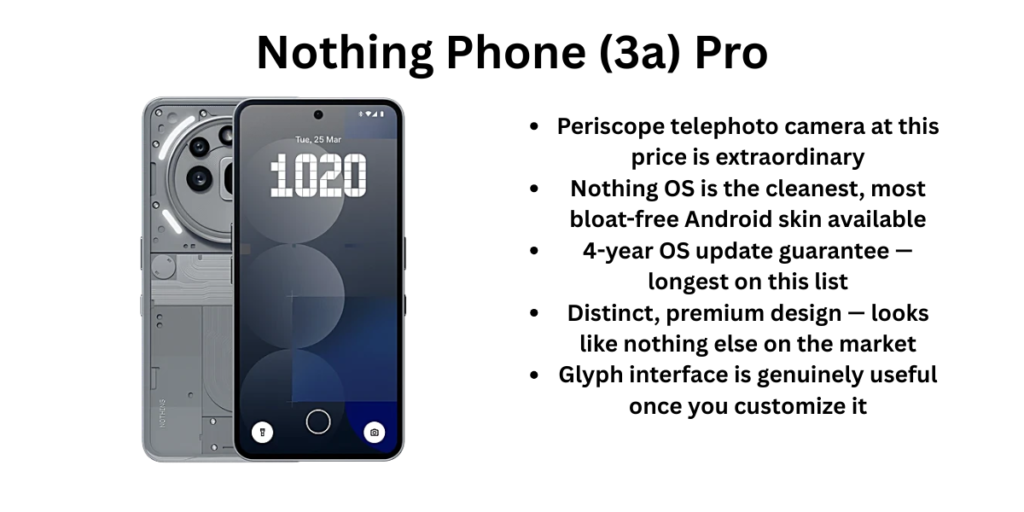
Nothing is doing something genuinely different in a sea of lookalike smartphones. The Phone (3a) Pro doesn’t just stand out visually — it actually delivers where it counts, especially on cameras.
The Nothing Phone (3a) Pro offers a triple camera setup with a 50MP main sensor, a 50MP periscope telephoto, and an 8MP ultrawide lens. A periscope telephoto at this price point is almost unheard of — that’s technology usually reserved for phones at ₹60,000+. It allows for more optical zoom with less distortion and is particularly useful for portraits, travel photography, and shots of subjects at distance. Techlusive
With Nothing OS, a versatile camera setup, and a bright 120Hz OLED display, the Nothing Phone (3a) Pro champions its place as one of the best mid-range smartphones available, even after several months on the market. The overall package is stylish, clean, and thoughtfully built.
The Glyph Interface — the LED light patterns on the back — is a genuinely clever feature that’s grown into a practical tool: you can assign specific glyph patterns to contacts, assign them as a flip-to-mute indicator, or use them as a notification light while the phone is face down. It sounds gimmicky until you use it daily.
Nothing commits to 4 years of Android updates and 5 years of security patches — the best software longevity on this list.
Pros:
- Periscope telephoto camera at this price is extraordinary
- Nothing OS is the cleanest, most bloat-free Android skin available
- 4-year OS update guarantee — longest on this list
- Distinct, premium design — looks like nothing else on the market
- Glyph interface is genuinely useful once you customize it
Cons:
- Snapdragon 7s Gen 3 is mid-tier — not ideal for heavy gaming vs. Snapdragon 8s Gen 3 options
- 5,000mAh battery is the smallest on this list; won’t last heavy users past 6 PM
- 45W charging feels slow next to competitors offering 80W+
- Priciest on this list at ~₹29,999
Who Should Buy It: Photography enthusiasts who want optical zoom without spending ₹50,000+. Design-conscious buyers who are tired of every Android phone looking the same. Users who plan to keep their phone for 4+ years and care about software support.
4. Realme 15 Pro — Best Battery Life + Camera Combo
Starting Price: ~₹27,999 (Flipkart)
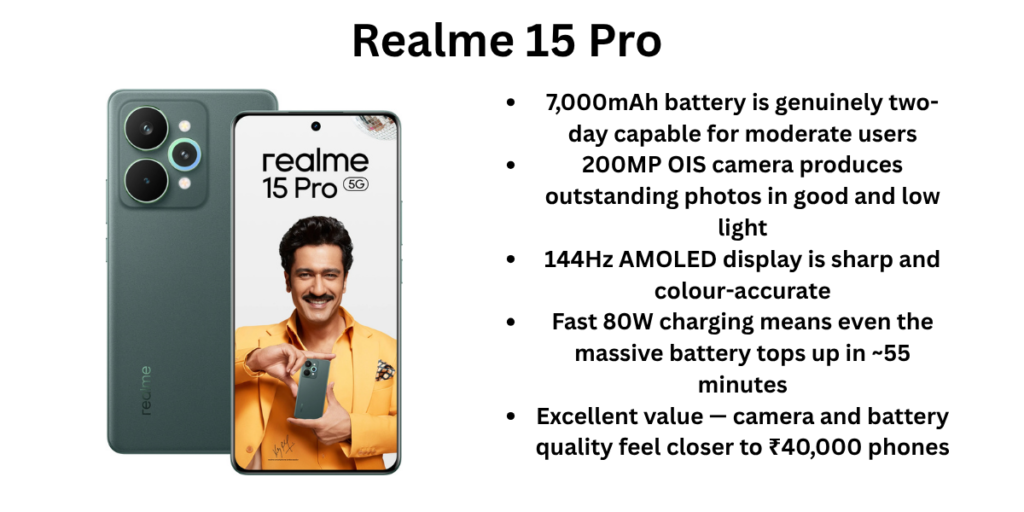
Realme has had a habit of throwing specs at the wall and seeing what sticks. With the Realme 15 Pro, they’ve stuck the landing. This is the phone for people who are always searching for a charger by 7 PM — it has one of the biggest batteries in this segment paired with a camera that punches well above its weight.
The Realme 15 Pro features a massive 7,000mAh battery and class-leading cameras for a mid-range phone, punching well above its weight with a stunning design.
The camera here uses a 200MP OIS primary sensor — and while megapixel counts are often marketing noise, the OIS (Optical Image Stabilisation) on the primary lens makes a real difference when shooting at night or recording video while moving. Realme’s image processing has matured considerably, and low-light shots from the 15 Pro consistently rank among the best under ₹30,000.
The 144Hz AMOLED display is vibrant and smooth, and Realme UI has gotten less cluttered with each iteration — still not Nothing-clean, but much better than it used to be.
Phones like the Realme 16 Pro 5G (7,000mAh) are highlighted for offering some of the best battery life in the under-₹30,000 segment. Cashify
Pros:
- 7,000mAh battery is genuinely two-day capable for moderate users
- 200MP OIS camera produces outstanding photos in good and low light
- 144Hz AMOLED display is sharp and colour-accurate
- Fast 80W charging means even the massive battery tops up in ~55 minutes
- Excellent value — camera and battery quality feel closer to ₹40,000 phones
Cons:
- Realme UI still carries some bloatware — expect pre-installed apps you won’t use
- Only 3 years of OS updates (vs. Nothing’s 4)
- Thicker and heavier than competitors due to the large battery — some users find it uncomfortable in jeans
- Ultrawide camera is decent but trails the Motorola Edge 60 Pro
Who Should Buy It: Heavy users, travelers, or anyone who forgets to charge their phone. Parents who hand their phone to kids for YouTube. Outdoor workers who need all-day battery without anxiety. Also a strong pick for casual photographers who want consistently good shots without fiddling with settings.
5. OnePlus Nord CE 5 — Best Clean Software Experience
Starting Price: ~₹24,999 (Amazon)
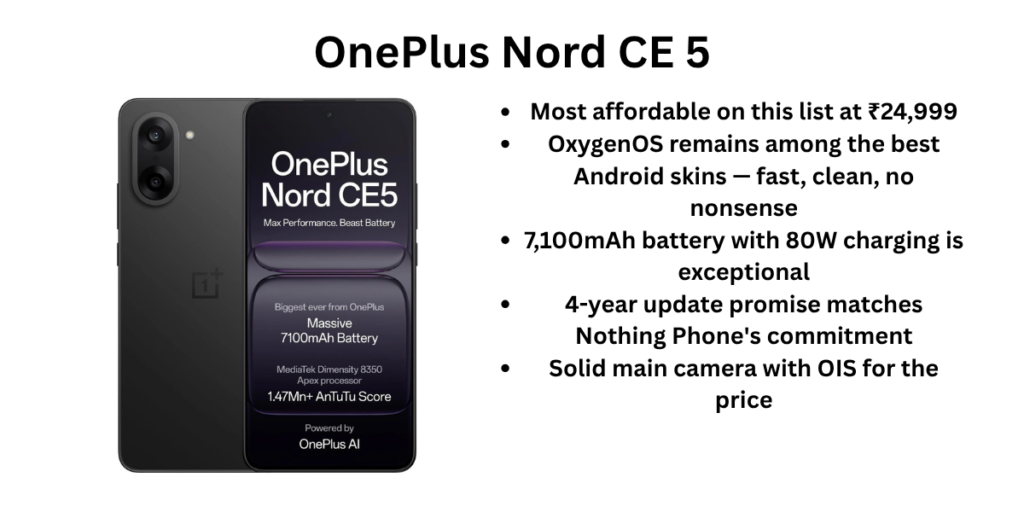
The OnePlus Nord CE 5 is the value champion on this list — it costs the least, ships with one of the best software experiences available, and packs a battery so large it’ll outlast most weekends.
The OnePlus Nord CE 5 runs OxygenOS 15 based on Android 15, and is powered by the Dimensity 8350 Apex chipset. OxygenOS has long been praised for its speed, responsiveness, and minimal interference — it feels close to stock Android but with genuinely useful additions like shelf widgets and Always-On Display customization. Digit
The standout spec here is the 7,100mAh battery — one of the largest on this list. Paired with 80W charging, you’re looking at a phone that can realistically last a day and a half on moderate usage, and still top up in under an hour.
The 6.78-inch AMOLED display at 120Hz is crisp, and the 50MP main camera with OIS handles daylight photography well. Portrait mode is particularly reliable for social media.
OnePlus commits to 4 years of Android updates and 5 years of security patches on CE-series phones — excellent longevity for the price.
Pros:
- Most affordable on this list at ₹24,999
- OxygenOS remains among the best Android skins — fast, clean, no nonsense
- 7,100mAh battery with 80W charging is exceptional
- 4-year update promise matches Nothing Phone’s commitment
- Solid main camera with OIS for the price
Cons:
- Ultrawide camera is below par compared to Motorola Edge 60 Pro
- No telephoto lens
- Design is safe and a bit forgettable
- No IP rating on base variant
Who Should Buy It: First-time Android buyers, students on a tight budget who don’t want to compromise on software quality, or anyone who loved OxygenOS on older OnePlus phones. If ₹5,000 matters to you (and it should — that’s a lot of money), this phone makes that saving completely painless.
6. Samsung Galaxy M56 5G — Best for Samsung Ecosystem Users
Starting Price: ~₹27,999 (Amazon/Flipkart)
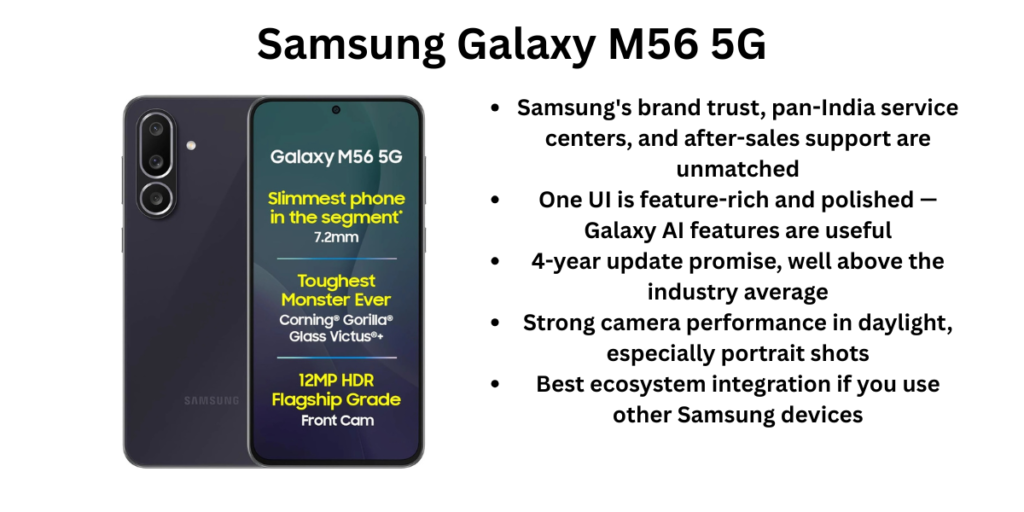
If you’re already in the Samsung ecosystem — SmartThings, Galaxy Watch, Galaxy Buds — or if you simply want the familiarity and after-sales support that Samsung offers across every city in India, the Galaxy M56 5G is a strong pick.
Samsung Galaxy smartphones in the under-₹30,000 range offer an excellent balance of performance, design, camera quality, and advanced features, suitable for work, entertainment, and everyday productivity.
The M56 5G runs on Samsung’s Exynos 1580 chipset paired with a 6,000mAh battery and a 120Hz Super AMOLED display. Samsung’s One UI is packed with features — multitasking tools, DeX-like windowing, Samsung DeX support — and the Galaxy AI features are genuinely useful for things like live translation and Circle to Search.
Samsung phones in this segment come with fast charging support and power-efficient processors, which allow all-day usage with minimal downtime. Samsung
Samsung promises 4 years of Android OS updates and 5 years of security patches on M-series phones — matching the best on this list.
Pros:
- Samsung’s brand trust, pan-India service centers, and after-sales support are unmatched
- One UI is feature-rich and polished — Galaxy AI features are useful
- 4-year update promise, well above the industry average
- Strong camera performance in daylight, especially portrait shots
- Best ecosystem integration if you use other Samsung devices
Cons:
- Exynos 1580 trails Snapdragon 8s Gen 3 in raw gaming performance
- One UI has more bloatware than most competitors — Samsung apps and partner apps pre-installed
- Heavier than alternatives at similar price points
- Camera can struggle in low-light vs. iQOO Neo 10R and Realme 15 Pro
Who Should Buy It: Anyone upgrading from an older Samsung who wants continuity without learning a new ecosystem. Users who prioritize after-sales support and service availability (especially in Tier 2 and Tier 3 cities). Families who use Samsung tablets or wearables alongside their phone.
How to Choose: A Quick Decision Guide
Before you buy, ask yourself these three questions honestly:
1. What do I actually do on my phone most?
- Gaming & heavy apps → iQOO Neo 10R
- Photography & zoom shots → Nothing Phone (3a) Pro or Motorola Edge 60 Pro
- Just daily use, calls, YouTube, social media → OnePlus Nord CE 5 saves you ₹3,000–₹5,000
2. How long do I plan to keep this phone?
- 2–3 years → Any phone on this list is fine
- 4+ years → Nothing Phone (3a) Pro or OnePlus Nord CE 5 (both offer 4-year OS updates)
3. Do I care about battery anxiety?
- Yes → Realme 15 Pro (7,000mAh) or OnePlus Nord CE 5 (7,100mAh)
- No → iQOO Neo 10R or Motorola Edge 60 Pro are fine
Final Verdict
There’s no single “best” phone here — but there are clear winners by use case.
For most people, the iQOO Neo 10R or Motorola Edge 60 Pro represents the best all-round value at roughly ₹27,000. The iQOO wins on raw speed; the Motorola wins on camera flexibility and software cleanliness.
For photographers who want optical zoom without breaking the bank, the Nothing Phone (3a) Pro is in a category of its own — the periscope telephoto at this price is genuinely remarkable.
For budget-conscious buyers who still want a quality experience, the OnePlus Nord CE 5 at ₹24,999 offers more than phones at ₹3,000–₹5,000 more.
For Samsung loyalists, the Galaxy M56 5G is the safe, sensible choice — especially if you value after-sales support.
Whatever you choose from this list, you’re getting a phone that would’ve easily cost ₹40,000–₹45,000 just two years ago. The ₹30,000 segment in India has never been this good, and that’s genuinely exciting.
Frequently Asked Questions
Which is the best phone under ₹30,000 in India in 2026? For most users, the iQOO Neo 10R or Motorola Edge 60 Pro. For camera enthusiasts, the Nothing Phone (3a) Pro. For budget-conscious buyers, the OnePlus Nord CE 5.
Is 5G worth it under ₹30,000? Yes. All six phones on this list are 5G-capable. Indian 5G networks are now available across most major cities, and buying a 4G phone today means you may need to upgrade sooner.
How many years of updates should I expect? Nothing Phone (3a) Pro and OnePlus Nord CE 5 both promise 4 years of Android OS updates. Samsung Galaxy M56 5G also commits to 4 years. Others offer 3 years, which is still adequate for most users.
Which phone has the best camera under ₹30,000? The Nothing Phone (3a) Pro for optical zoom and versatility. The Realme 15 Pro for megapixel quality and low-light shots. The Motorola Edge 60 Pro for a balanced triple-camera system.
Should I wait for new launches? The OnePlus Nord CE 6 and similar next-gen devices are arriving, but the phones on this list remain excellent value right now. If you need a phone today, don’t wait — the prices on the above models have already dropped since launch.
Also read: 6 Best Smartphones Under ₹20,000 in India